

- Article published at:
- Article author: Emily Trampetti
- Article tag: Advanced Treatments
By Emily Trampetti, Licensed Esthetician & Skin Strategist Skin Property Esthetics | Winter Garden, FL + Virtual Coaching Nationwide
Exosomes are everywhere on social media and #SkinTok right now. Some are calling them the next big thing after retinol, or the next big thing after peptides. It's the newest rage ingredient everyone is talking about, and maybe even gatekeeping!
So let's clear this up and give you the facts, the credible data, and a clear understanding of what you actually need to know about these promising little ingredients. Because they are worth paying attention to. They're also one of the most misunderstood ingredients I've seen come through this industry, and almost nobody online is explaining the one detail that decides whether they do anything at all.
Let's break it down the way I break everything down before it earns a spot in my treatment room: what is it, how does it actually work, what does the research say, and, most importantly, is it worth your valuable time and money!
What Exosomes Actually Are
Exosomes are essentially tiny particles, or vesicles, that your cells naturally release into the space around them that carry along proteins, RNA, and other molecules and "cargo" that need to be sent to other cells for initiating healing, repair and other functions. In this way, it's tempting to call exosomes "messengers," like they're having a conversation with your skin cells, but that's not really how they work despite how some explain their function, especially when it comes to skincare innovation.
A better way to picture it is that exosomes work more like a keycard than a letter. A keycard doesn't say anything. It doesn't explain, negotiate, or adjust based on the situation. It just gets scanned, matched against something the system already recognizes, and it triggers the same response every time. Your skin cells work the same way. When they detect an exosome, they're not reading a custom message. They're recognizing a familiar signal and reacting with a response they were already built to perform, usually some version of "start repairing" or "reinforce the skin barrier."
So, to clarify, exosomes are not smart. They're not adaptive. The intelligence is entirely on your skin's side. The exosome is just the trigger. Which brings up the obvious next question: who's deciding what's on that keycard in the first place?
How the Cargo Actually Gets In There
Short answer? Nobody. At least not in the naturally occurring exosomes used in skincare.
Think about what happens when you fold laundry in a hurry. You're not carefully deciding what goes where (maybe you are ;). You're more likely grabbing whatever's closest and already sorted. Exosome formation works almost exactly like that. As the vesicle buds off from the cell, it scoops up whatever proteins and genetic material the cell happened to be using in that moment. The final contents are basically a snapshot of what that cell was doing, not a custom-built package assembled with your skin's dark spots in mind.
That snapshot idea matters, and it raises an obvious question: if your body already does this constantly, why would you ever need help from the outside?
Why We're Even Talking About This
Your body has been taking these snapshots your entire life, so if your cells already know how to do this, why bother with more? Because the quality of that snapshot changes as your cells age. Young, healthy cells take good ones, packed with repair and rebuilding signals. Older or stressed cells take worse ones, fewer regenerative signals and more inflammatory ones mixed in. Same photo booth, different film.
That decline is part of why skin loses its ability to bounce back the way it used to, and it's exactly the gap professionally sourced exosomes are trying to help fill back in. That's the whole reason this ingredient is worth talking about at all, not because it's new, but because it's aimed at a very specific, well documented weak spot in aging skin.
But It's Complicated
First of all, it may be tempting to assume all new and old skincare ingredients are just things we can easily mix into a formula and, wham-bam-thankyou-ma'am apply to the skin for results. It may not be surprising to know that it is MUCH MORE complicated than this. Between our skin's strong ability to keep things out, navigating stability and proper biological function, and sourcing, not to mention a hundred other factors, there's a lot to consider.
Let's start by talking about the size of these exosomes. They are big! Like 30 to 150 nanometers big. Your skin's outer barrier, the stratum corneum, exists specifically to keep particles that size out. Think of your skin barrier as a security checkpoint. It's built to stop almost everything from getting through, on purpose. That's not a flaw. That's your barrier doing exactly its job. So before you buy an exosome serum meant for home use, ask yourself this: if nothing that size can get through intact skin, what is that serum actually doing just sitting on top of it? Most likely it's not the exosome that's doing a job, but rather an auxiliary ingredient not getting marketing cred on the label. But you're probably still paying for the "exosome" name, the same premium we already talked about.
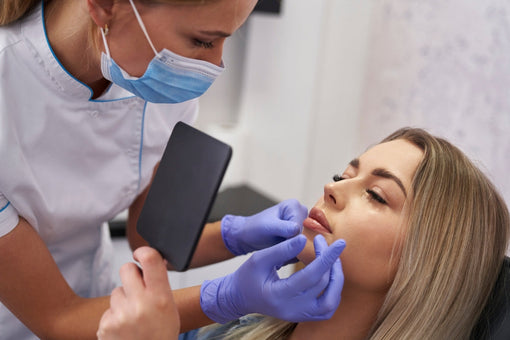
So we first have to make sure they can get in the skin if they are going to work at all. In my studio, I'm not slapping an exosome serum on top of the skin and hoping for the best. That's not how any of this works. I'm creating a temporary, controlled side door in the skin first, so they can get through, with treatments like nanoinfusion, microneedling, spicule based treatments, or certain electrotherapy modalities. That opening is what gives exosomes an actual path past your skin's natural defenses and into tissue where they can go to work.
There's real research behind this, too, not just clinic anecdotes. In an animal study, researchers tested a microneedle patch built with an added suction mechanism against standard microneedling alone, using stem cell derived extracellular vesicles, the broader particle family exosomes belong to. The suction-assisted version delivered those vesicles nearly three times deeper into skin, 290 micrometers versus 111, and that deeper delivery translated into measurably better fibroblast activity and collagen production. It's mouse data, not human, so treat it as a proof of concept rather than a guarantee. But the underlying point holds up: depth isn't a minor detail. It's the difference between a treatment that works and one that just feels nice sitting on your bathroom counter.
This is exactly why I pair exosomes with proper delivery treatments in my treatment room instead of sending clients home with a bottle and a prayer. Spoiler alert: I wouldn't waste money on any topical exosome product right now! The treatment itself is what makes the ingredient worth anything at all.
And How We Make Them Matters, Too
Here's another wrinkle worth knowing before you hand over your card: not every exosome you'll see marketed is even the same kind of exosome. Stay with me here.
This is where the keycard idea gets even more useful, especially once you realize "exosome" isn't one single, standardized thing. They can come from very different sources, human or stem cell derived, or plant and bacterial derived, and despite sharing a name on an ingredient label, they are not interchangeable.
Human derived exosomes are like getting a text from a close friend, in that your cells fluently understand exactly what's being communicated because it's coming from the same type of cell speaking the same biological language. But the problem with human-derived exosomes is that there can be some real safety and health concerns.
Bacterial derived exosomes, like the ones I use, are more like a text in a language your phone can't quite translate. Your skin cells don't fluently "speak bacteria," but they do have built in alarm systems that recognize when a microbial signal shows up, since your skin has been coexisting with bacteria since the day you were born, and that recognition alone is enough to trigger a protective response, generally centered on calming inflammation and reinforcing the barrier, which is precisely what we want! And we can better control the quality and safety of the exosomes.
But Be Prepared... They Don't Come Cheap
The exosomes I use come from a bacterial strain called Lactobacillus brevis, the same family of bacteria behind fermented foods like kimchi. The specific strain in my product was actually isolated from Korean fermented radish. The production process is basically fermentation, then careful filtering. The bacteria are grown in a nutrient broth, scaled up in a fermenter for about two days, then spun down to separate the bacteria from the surrounding fluid. From there it gets filtered to remove leftover broth material, then passed through an extremely fine membrane filter that lets exosomes through while blocking anything larger. Researchers confirm what's left is genuinely exosomes using specialized imaging and particle tracking equipment.
No synthetic assembly. No lab-built particle. It's fermentation, filtration, and verification, which is a far more grounded story than most people assume when they hear "lab made." All that specialized growing, filtering, and verifying is exactly why harnessing exosomes for skincare doesn't come cheap, and it's worth understanding before the price tag catches you off guard. If you've priced out an exosome treatment or serum, you've probably had a moment of sticker shock because these trendy products are PRICEY!
You may be asking yourself, if they are so naturally derived, why are they so expensive? The truth is more about time and process. You're not just mixing ingredients in a vat the way most skincare gets made, you're growing living cells, waiting for them to naturally release these particles, then running that liquid through multiple rounds of filtering and purification just to isolate a small, usable amount. On top of that, verifying you actually have real exosomes requires specialized lab equipment most cosmetic manufacturers don't already own, and because there's no FDA approved pathway for cosmetic exosomes yet, there's also no standardized, at-scale manufacturing process the industry has settled on, so costs haven't come down the way they eventually do for an established ingredient.
The less legitimate part is simple hype. Exosomes are trending hard right now, and pricing reflects that as much as it reflects production cost, meaning some of what you're paying for is genuine lab work while some of it is a markup tacked on because the word sells right now, the same way any buzzy ingredient gets pricier the moment it goes viral, whether or not the manufacturing complexity actually justifies it.
How I'm Using Them With Confidence
After going through all of this, here's where I land, and where you'll find me every time this comes up in a consult. I believe there is promise with certain exosome technology and currently use Mediderma's (Spain) exosome innovation with nanoneedling, spicule peels and electrotherapy mesotherapy in my treatment room, and I've watched it deliver real, visible results for clients working on a myriad of skin conditions.
That confidence isn't blind. It's built on understanding exactly what's happening at each step: the delivery method doing the heavy lifting, the clarifying complex handling the direct pigment work, and the exosomes supporting a calmer, more efficient healing process underneath all of it. That's the difference between confidence and hype. I'm not telling you exosomes are magic. I'm telling you I understand the mechanism, I've seen it work in my own treatment room, and I trust the process because I know exactly what's happening at every step, not because a label told me to.
The Bottom Line
Exosomes are a perfect example of a pattern I see constantly, where social media is a great way to hear about what's new but a terrible place to decide what's actually worth your money. Trends move fast there because attention moves fast, not because the science does, and nuance simply doesn't get views the way confidence does, even when that confidence isn't earned (which is commonplace ;).
That's exactly why it matters to have a knowledgeable, licensed esthetician and skin pro in your corner, someone who sits with the research, understands how ingredients and delivery methods actually work together, and tells you the truth about what's worth trying and what's not worth your time, effort, or hard earned money, rather than someone selling you whatever's trending this month. And for exosomes specifically, that truth is simple: save your money on the serum, and save the real results for the treatment room. Also, if your practitioner can't explain what and why they are doing what they're doing on your skin, just politely don't come back.
If you saw an exosome treatment on your feed and want a straight answer on whether it's worth booking, that's exactly the kind of conversation I love having in a consult. Bring me the screenshot. Bring me the claim. Let's look at it together.
Whether you're here in Winter Garden or working with me virtually from anywhere else, I'm not chasing trends with you. I'm helping you cut through them and find what's right for YOUR SKIN!
Skin Property Esthetics | Winter Garden, FL Serving clients virtually across the U.S. and beyond BOOK YOUR APPOINTMENT HERE!
Sources referenced:
Cho YH, Kim JW, Kim N, et al. Lactobacillus brevis-Derived Exosomes Enhance Skin Barrier Integrity by Upregulating Key Barrier-Related Proteins. Clinical, Cosmetic and Investigational Dermatology, 2025.
Liang C, Yi Y, Li J, et al. Unveiling Exosomes in Combating Skin Aging: Insights into Resources, Mechanisms and Challenges. Stem Cell Research & Therapy, 2025.
Systematic review of exosome-based therapies for skin rejuvenation, human studies (2026)
Suction-assisted microneedle patch and extracellular vesicle penetration depth, animal study, Nano-Micro Letters (Springer Nature), 2025
Mediderma EXOSES LW product documentation
Industry market analysis on exosome skincare production costs
Learn More